
Designing AI Products That Users Actually Trust
Getting the architecture right is necessary. Getting the agent to work in production is necessary. But neither of those things matters if the user opens the product, gets a wrong answer, and never comes back.
Trust is a design problem — and most AI products treat it as an afterthought.
The founders who think about trust only after the product is built are solving it too late. By then, the architecture makes certain design patterns expensive to add. The UX patterns that build trust aren’t decorative — they’re structural. They need to be designed in, not bolted on.
This chapter is about what that looks like in practice.
UX for products that make mistakes by design
Traditional software has bugs. When a bug appears, it’s anomalous — something went wrong that wasn’t supposed to. You fix it, and the product returns to its normal state of being correct.
AI products work differently. Errors aren’t anomalous. They’re statistically inevitable. Given enough interactions, the model will produce something wrong, incomplete, or confidently incorrect. This isn’t a flaw in the product — it’s a property of the technology. And it changes the design contract fundamentally.
In traditional software, you design for the happy path and handle errors as exceptions. In AI products, you design for the assumption that the output might be wrong — and make sure the user can tell, and can do something about it.
“Traditional software has bugs. AI products have a different problem: outputs that are wrong but look right. Design for that, or your users will discover it for you.”
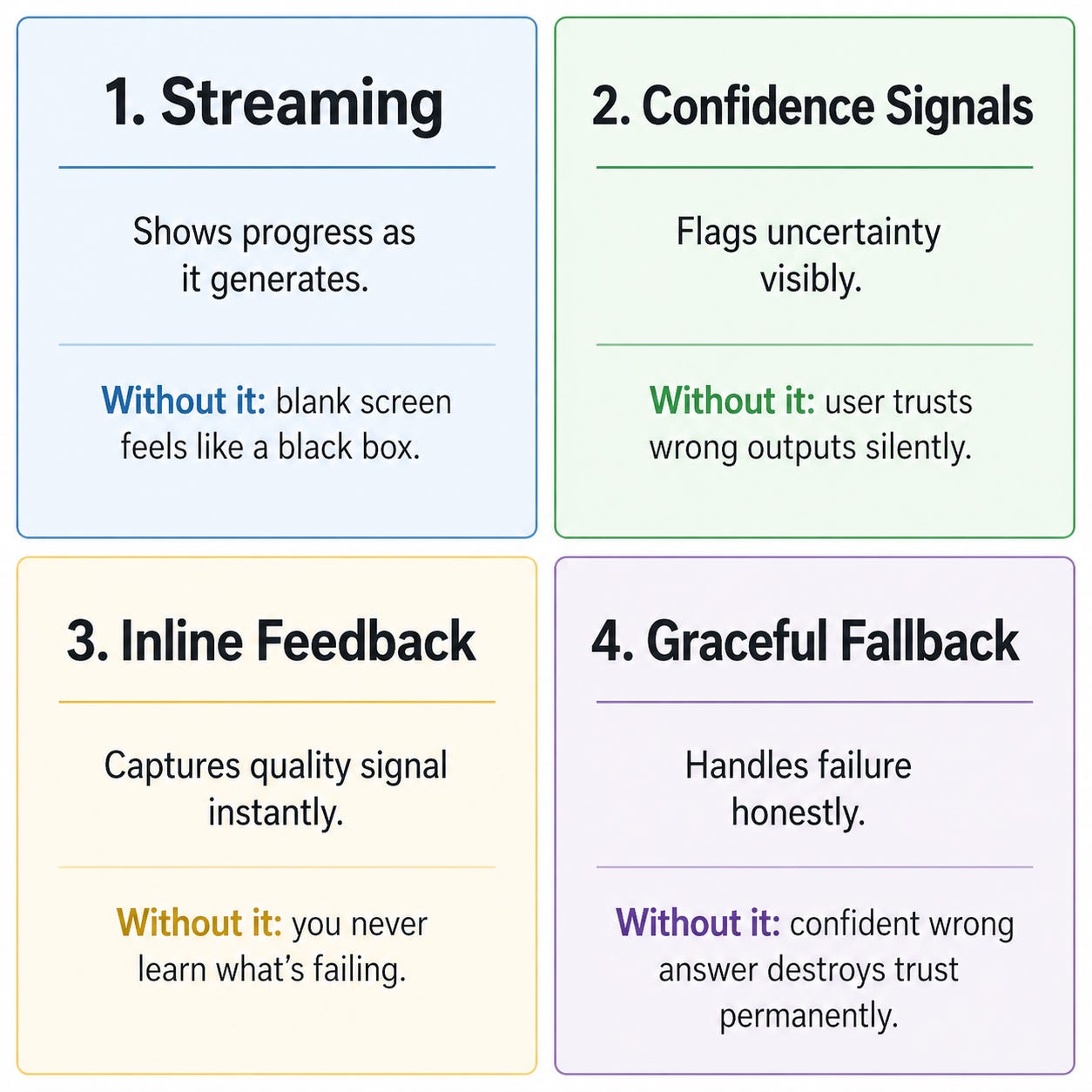
Four patterns that separate AI products designed for trust from those that aren’t:
Streaming. Show the response as it generates, rather than making the user wait for a complete answer. This isn’t just a performance trick — it’s a trust signal. A user watching a response form in real time understands that something is happening, can start reading before the output is complete, and can interrupt if the response is going in the wrong direction. A blank screen that suddenly fills with text feels like a black box. A response that builds word by word feels like a process. Architectural note: streaming requires your API layer to return tokens progressively rather than buffering the complete response — a design decision, not an optimization you add later.
Confidence signals. When the model is uncertain, say so — in the interface, not just in the output text. Source citations that show where information came from. Visual indicators that distinguish retrieved facts from inferred conclusions. Language that flags low-confidence outputs: “based on limited information,” “you may want to verify this.” The goal isn’t to undermine the product — it’s to give the user enough signal to know when to trust and when to check. Architectural note: confidence signals require your pipeline to distinguish between retrieved content and generated content — which means retrieval and generation need to be separate, trackable steps.
Inline feedback. Make it trivially easy for the user to say the output was wrong. Thumbs up/down. Direct editing of the output. A single-click rejection. Every one of these interactions is a quality signal — and collected at scale, they become the data that makes the product better. The harder you make feedback, the less of it you get. The less of it you get, the slower the product improves. Architectural note: feedback signals are only useful if they’re stored against the specific input-output pair that generated them — which means you need logging infrastructure before you need a feedback UI.
Graceful fallback. When the model doesn’t know, the product should say so — clearly, helpfully, without pretending. A response that says “I don’t have enough information to answer that reliably — here’s what I do know” builds more trust than a confident wrong answer. And a confident wrong answer that the user discovers later destroys more trust than any number of honest admissions of uncertainty. Architectural note: graceful fallback requires explicit detection logic — the pipeline needs to identify low-confidence or out-of-scope outputs before they reach the user, not after.
A useful question for your next product review: when our product gives a wrong answer — can the user tell? And can they correct it in under ten seconds? If the answer to either is no, you have a trust design problem.
Trust doesn’t happen on day one
There’s a pattern in how users adopt AI products that most founders underestimate: trust is built in layers, over time, through repeated evidence that the product is reliable. You can’t compress it. You can’t ask for it upfront. And if you design the product as though the user already trusts it — giving it full autonomy from the first interaction — you’ll see abandonment before you see adoption.
The right mental model is a spectrum of autonomy. At one end, the product suggests and the user decides everything. At the other, the product acts and the user spot-checks. The journey from one end to the other takes time — and the product needs to be designed to support that journey, not skip it.
“Trust isn’t something you ask for on day one. It’s something you earn interaction by interaction — by being right often enough, and being honest about it when you’re not.”
Three design decisions that determine how that journey goes:
Transparency versus magic. There’s a genuine tension in AI product design between showing the reasoning and hiding it. Showing the reasoning builds trust — users understand how the conclusion was reached and can evaluate it. Hiding it creates a cleaner experience — the user gets the answer without wading through the process.
The resolution isn’t “always show” or “always hide” — it’s calibrated to risk. A music recommendation can be magic. A medical suggestion, a legal interpretation, a financial recommendation — these need to show their work. The higher the stakes of acting on a wrong output, the more the user needs to understand how the output was produced. Design for transparency where it matters, and reserve magic for where it doesn’t.
Hallucination as a design constraint, not just a technical problem. Every AI product that operates in a high-stakes domain — healthcare, legal, finance, compliance — needs to treat hallucination as a design input, not just something to minimize on the engineering side. The question isn’t only “how do we reduce hallucination?” It’s “how do we design the product so that when hallucination happens, the consequences are manageable?”
That means: never displaying AI-generated content without a verification path. Designing flows where high-risk outputs require confirmation before action. Making it structurally easy for the user to check a claim before relying on it. Hallucination won’t go to zero — but its impact can be designed around.
Progressive autonomy. The product starts by suggesting, not doing. As the user sees consistent quality — as evidence accumulates that the product is reliable for a given type of task — the product can take on more. An email drafting tool that starts by proposing subject lines before drafting full emails. A scheduling tool that starts by suggesting times before booking them. A financial analysis tool that starts by flagging anomalies before escalating them.
This progression isn’t just good UX — it’s the path to the product becoming indispensable. Users who’ve watched the product be right fifty times in a row are ready to let it act on the fifty-first without review.
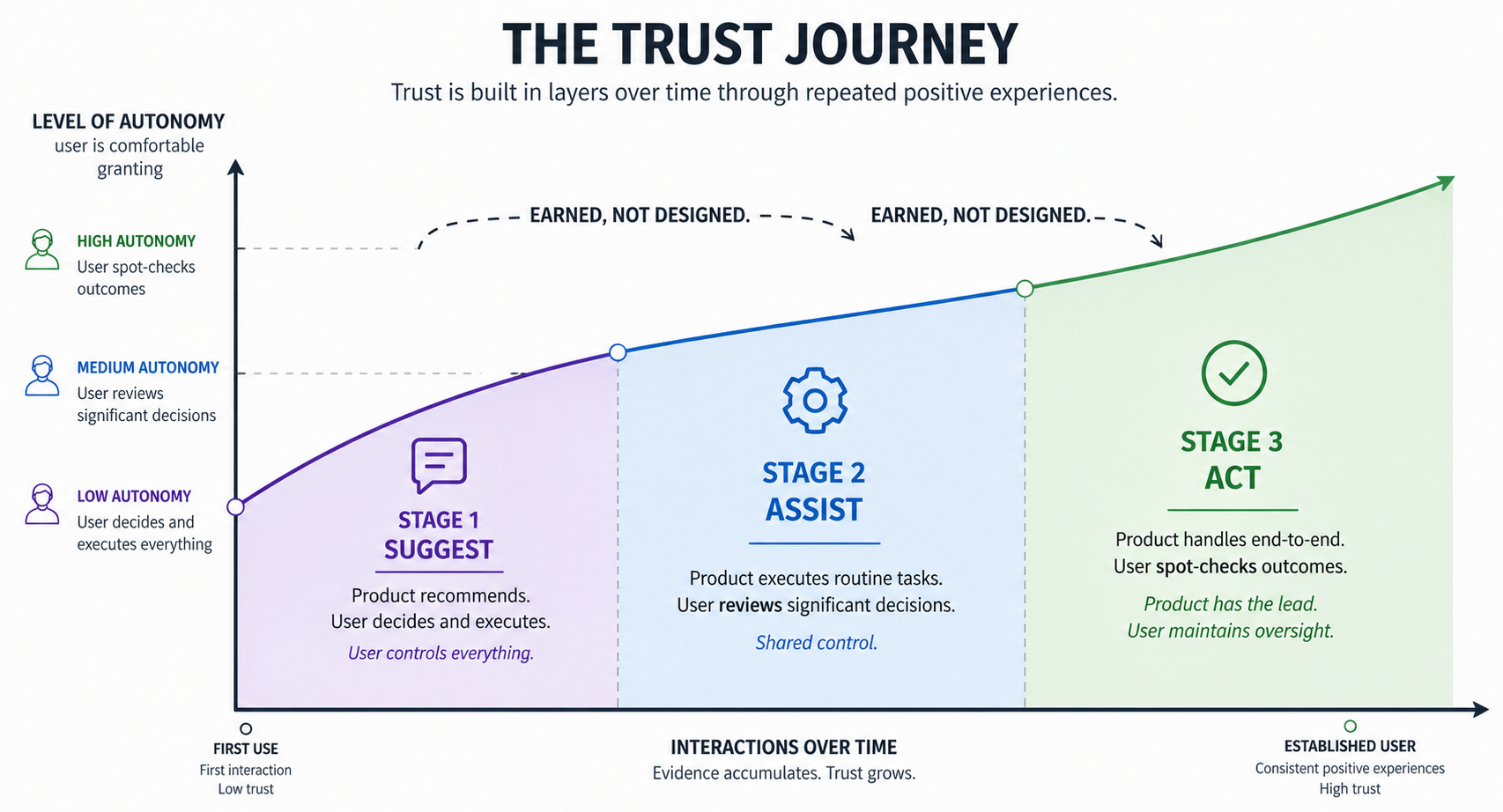
A useful question for your product and engineering team: where on this timeline are our current users — and is our product designed to help them move forward, or does it assume they’re already at Stage 3?
Where AI changes the product, not just a feature
There are two fundamentally different ways to have AI in a product.
The first: you have an existing product, and you add AI to make it better. The workflow is the same. The user experience is the same. AI makes some parts faster, or smarter, or more automated. This is AI-powered — and it’s valuable, but it’s incremental. The product is still recognizably what it was before.
The second: you build a product that assumes AI exists, where the workflow itself is different because AI makes it possible. The product doesn’t just do the old thing faster — it does things that weren’t possible before. This is AI-native — and it’s where the most interesting opportunities are.
The distinction matters because AI-native products can occupy entirely new territory. They don’t compete with the previous version of the same tool — they make the previous version obsolete.
“The most powerful AI products don’t add AI to what already existed. They do things that were never possible before AI — and then make them feel obvious.”
Three interaction patterns that only exist because AI makes them possible:
Proactive instead of reactive. Every traditional product is reactive: the user does something, the product responds. AI enables a different model: the product acts before the user asks. It detects that a contract is about to expire and surfaces a renewal draft. It notices a client’s usage has dropped and flags it before the renewal conversation. It identifies that a patient’s metrics are trending in a concerning direction and alerts the care team. This requires the product to have context — about the user, their patterns, their goals — and the judgment to know when surfacing something is helpful versus intrusive.
Generate instead of search. Traditional products present options; users choose. AI products can create the option — a draft, a summary, a recommendation — tailored to the specific context. A user browsing a list of template contracts is replaced by a user reviewing a draft clause generated for their specific deal. A user searching for competitor pricing is replaced by a user receiving a synthesized competitive analysis. The user’s role shifts from consumer to reviewer — which is a fundamentally different relationship with the product.
Conversation instead of form. Structured data entry — forms, dropdowns, fields — exists because computers needed structured input to function. AI removes that constraint. A user can describe what they need in natural language, and the product extracts the structure. An intake process that previously required fifteen fields can become a two-minute conversation. An expense report that required line-by-line entry can be generated from a photo of a receipt and a sentence of context. This isn’t just a UX improvement — it opens the product to users who would never have completed the form.
For founders who already have a product in production: you don’t need to rebuild from scratch to move toward AI-native. Three changes with the highest impact for the lowest effort — add proactive surfacing to one high-value workflow, replace one form with a conversational entry point, and add generation to one place where users currently browse and choose. Pick one. Prove it works. Then move to the next.
On implementation effort: proactive and generate are the lowest-effort starting points — they build on existing data and output capabilities you likely already have. Conversation instead of form is the most architecturally significant of the three, because it requires extracting structure from free text reliably at scale. If you’re choosing where to start, start there last.
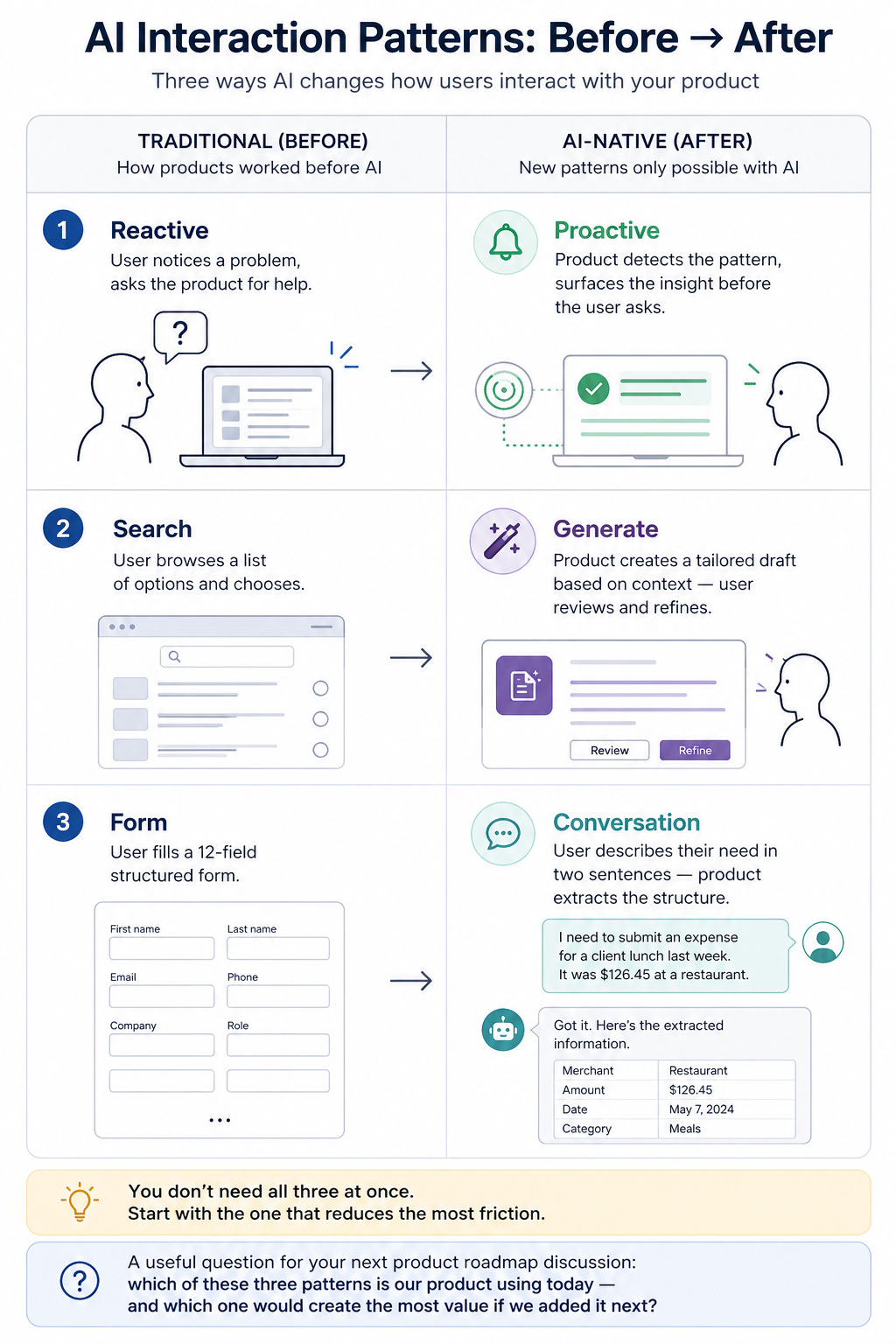
A useful question for your next product roadmap discussion: which of these three patterns is our product using today — and which one would create the most value if we added it next?
Building an AI product that users trust isn’t harder than building one they don’t. It just requires treating trust as a design constraint from the beginning — not a problem to fix after the fact.
The products that earn trust are the ones that are honest about uncertainty, transparent where stakes are high, and designed to grow into autonomy rather than assume it. Those aren’t compromises — they’re what makes the product worth using long-term.
The next chapter is about what happens once you have users who trust the product and use it at scale: the economics start to matter in ways they didn’t when you had a hundred users. Cost, quality, and latency become business problems, not engineering ones.
Chapter 6 of AI Engineering for Founders — Designing AI Products That Users Actually Trust. New chapters weekly.