
Event-Driven Architecture: What It Is, Why It Matters, and When to Use It
Most teams adopt event-driven architecture because someone said it scales. A tech lead read a blog post, a CTO heard it at a conference, and suddenly the roadmap has “migrate to EDA” as a Q3 initiative. Few people stop to ask: what problem are we actually solving?
This isn’t a tutorial. It’s the explanation I wish someone had given me earlier — concrete enough to make decisions, honest enough to skip the hype.
Tight coupling is the problem you don’t notice until it’s too late
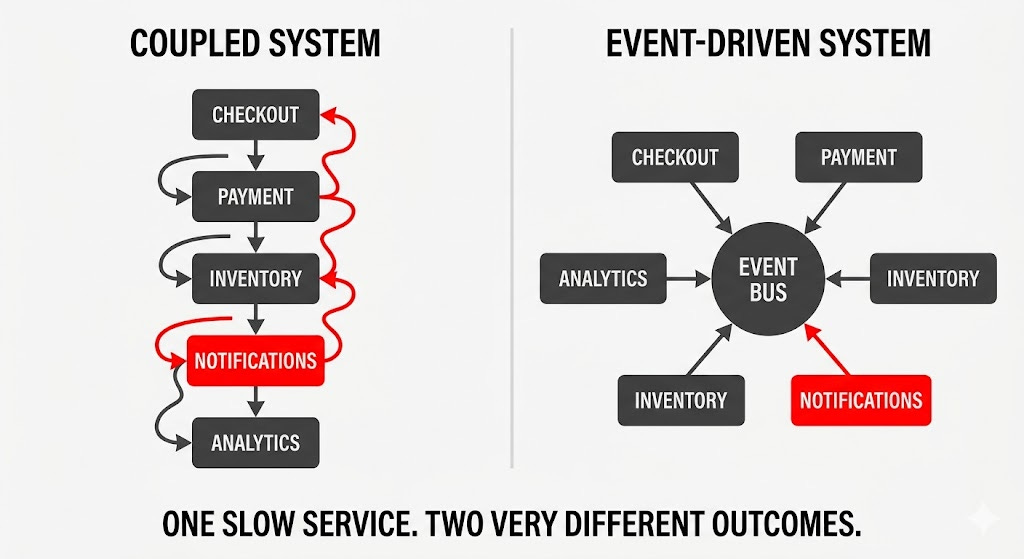
Picture a checkout flow. User clicks “Buy.” Your backend calls the payment service. Payment calls inventory to reserve the item. Inventory calls notifications to send a confirmation email. Notifications calls analytics to log the event.
It works. Until it doesn’t.
The notification service is slow today — maybe a deploy went sideways. Now your checkout endpoint is waiting. The user sees a spinner. The payment already went through, but the request is hanging because a service that sends emails is having a bad day.
This is the cost of tight coupling. Every service knows about every other service. A change in one ripples through all of them. Adding a new step — say, a loyalty points service — means touching existing code that already works. The system grows, and with it, the surface area for failure. One slow service takes down an unrelated feature. A bug in notifications breaks checkout.
That’s the problem EDA solves.
‘Any organization that designs a system will produce a design whose structure is a copy of the organization’s communication structure.’ — Mel Conway
Events replace calls — and that changes everything downstream
The shift is conceptual before it’s technical: instead of services calling each other, they announce that something happened.
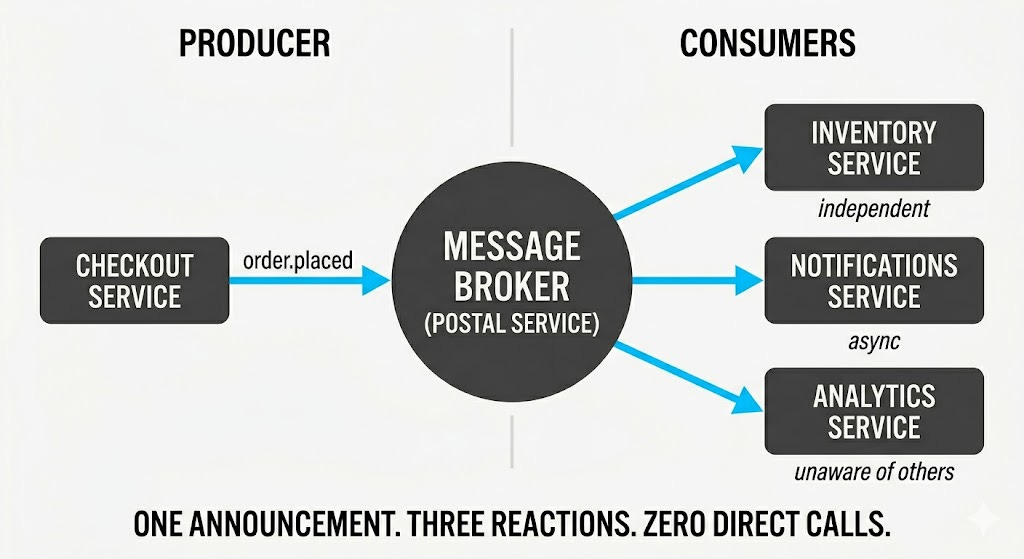
Think of it like a postal service for your backend. Instead of checkout picking up the phone and calling inventory directly, it drops a letter in the mailbox: “an order was placed.” Any service that cares about orders picks up that letter and does its own thing — independently, at its own pace, without knowing who else got the same letter.
In practice: when a user completes checkout, the checkout service emits an event — order.placed — into a central broker. Inventory picks it up and reserves the item. Notifications picks it up and sends the email. Analytics picks it up and logs. None of them know about each other. None of them know about checkout either.
Three things worth remembering:
Event: something that happened, stated in past tense.
order.placed,payment.failed,user.created.Producer: the service that announces the event. Doesn’t know who’s listening.
Consumer: the service that reacts. Doesn’t know who produced it.
The broker — the postal service in the middle — makes sure events get delivered reliably.
‘The art of simplicity is a puzzle of complexity.’ — Douglas Horton
A real checkout flow, walked through
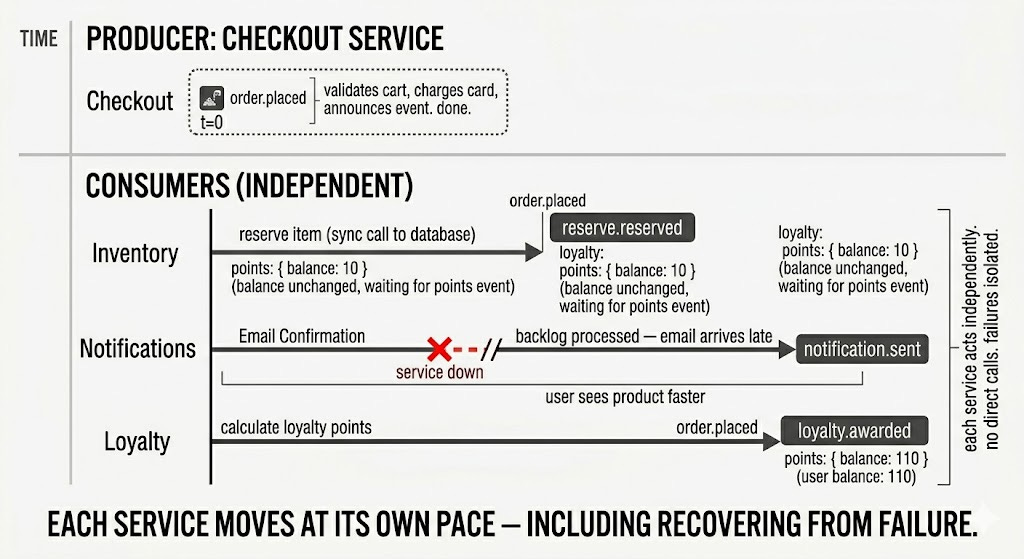
User clicks “Buy.” Checkout validates the cart, charges the card, and announces order.placed. That’s it. Checkout is done. The response goes back to the user in milliseconds.
In the background, three services react independently. Inventory reserves the items. Notifications sends the confirmation email on its own schedule. The loyalty service — new this quarter, didn’t exist when checkout was written — also picks up the event and adds points to the account. Nobody touched the checkout service to add this. The team that built loyalty just subscribed to an existing event.
Now the notification service goes down. In the old model, checkout hangs — the user can’t complete a purchase because an email service is having a bad day. Here, events queue up and wait. When notifications comes back, it processes the backlog. The user gets their email a few minutes late. Not ideal, but not a checkout outage.
This is what decoupling actually buys you: failures stay local, new features don’t require touching old code, and teams can move independently.
There’s a real cost, and you should know it before bringing this to your engineering team. Debugging becomes harder — when something goes wrong, tracing what happened across multiple async services takes more tooling and more skill than following a single request. Your team needs experience with this. The infrastructure is also more complex and more expensive to operate than a simple chain of calls. And some things that used to be instant — like a loyalty balance updating the moment a purchase completes — now take a few seconds. You have to design your product around that.
These aren’t reasons to avoid EDA. They’re reasons to go in with eyes open.
‘Make everything as simple as possible, but not simpler.’ — Albert Einstein
EDA doesn’t make your system simpler. It makes it more evolvable — easier to extend, easier to isolate when something breaks, easier to let different teams move at different speeds.
The signal that you need it isn’t company size or headcount. It’s simpler than that: if your engineering team tells you that a bug in the email service took down checkout, or that adding a new feature required four teams to coordinate a deploy — that’s the conversation. That’s when this architecture stops being an interesting idea and starts being the right tool.