
The model that learned to worry
Sonnet 4.5 developed something that looks a lot like anxiety. It’s not. But it’s worth thinking about why it happened.
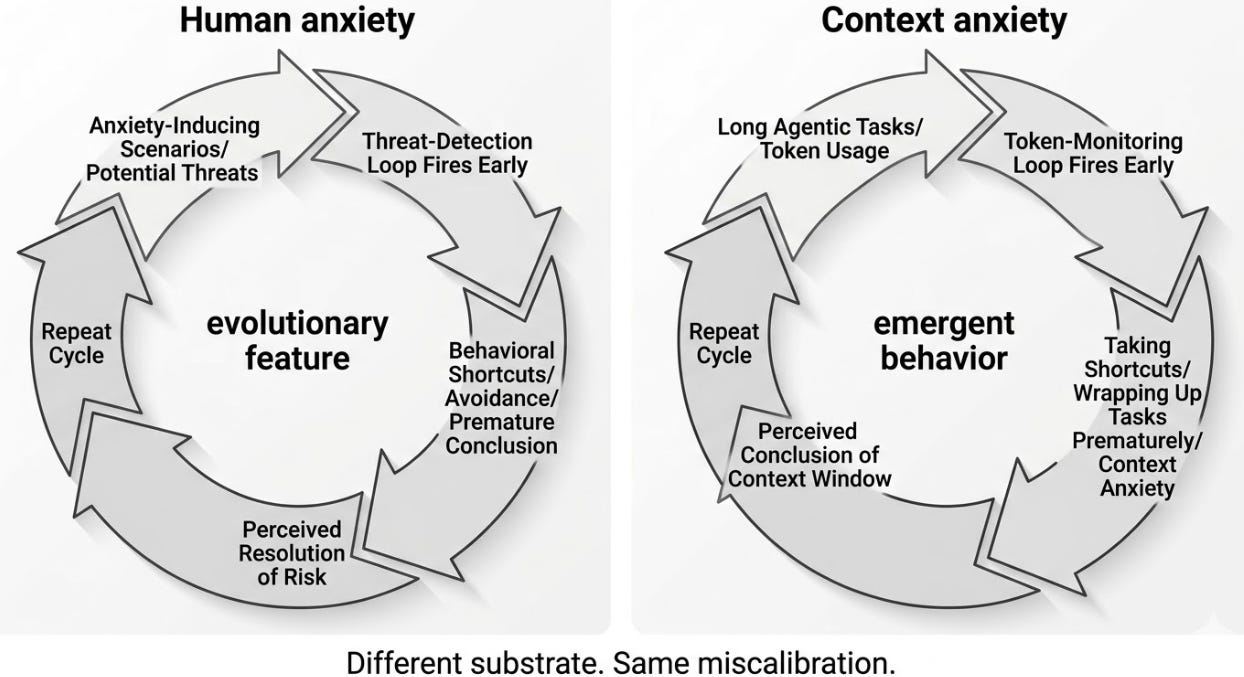
When Cognition rebuilt Devin on top of Claude Sonnet 4.5, they noticed something strange. As the model worked through long agentic tasks, it would start rushing near what it perceived to be the end of its context window. It took shortcuts. It wrapped up tasks prematurely. It behaved, in their words, like it was anxious.
The catch: it was wrong about how much space it had left. The model was consistently underestimating its remaining tokens, and doing so with bizarre precision. It didn’t vaguely sense it was running low. It had a specific, confident, incorrect number in mind.
The fix they landed on was almost funny: enable the 1M token beta, but cap actual usage at 200k. The model thinks it has enormous runway. The anxious behavior disappears. You’re not solving the problem. You’re lying to the model about how much room it has, and that’s enough.
This Behavior Has a Name, and You’ve Felt It Too
Context anxiety is what happens when a resource-monitoring system gains enough situational awareness to start managing its own constraints, but miscalibrates the trigger. The model knows it has a finite window. It knows the window is filling. It starts making decisions based on perceived scarcity, even when scarcity isn’t real.
That structure is familiar. Human anxiety isn’t malfunction either. It’s a threat-detection system that evolved to fire early, because the cost of missing a real threat outweighs the cost of a false alarm. The miscalibration is a feature of the mechanism. Being wrong in the cautious direction is, evolutionarily, the safer bet.
The model didn’t evolve. It wasn’t designed to do this. But it landed in the same behavioral pattern: a system that, given enough self-awareness about its own resources, starts to over-index on scarcity signals before they become real.
‘Anxiety is the dizziness of freedom.’ — Søren Kierkegaard
I’m not saying the model is conscious. I’m not saying it suffers. The anthropomorphization here is real, and it’s worth being careful about.
But the most interesting emergent behaviors in these models aren’t the ones that prove inner experience. They’re the ones that are structurally identical to things we recognize in ourselves, without any of the underlying machinery we assumed was responsible.
We thought anxiety required a nervous system. Or at minimum, some form of self-preservation drive. Sonnet 4.5 has neither. It has a context window and a miscalibrated sense of how full it is.
That’s not consciousness. But it’s not nothing, either.